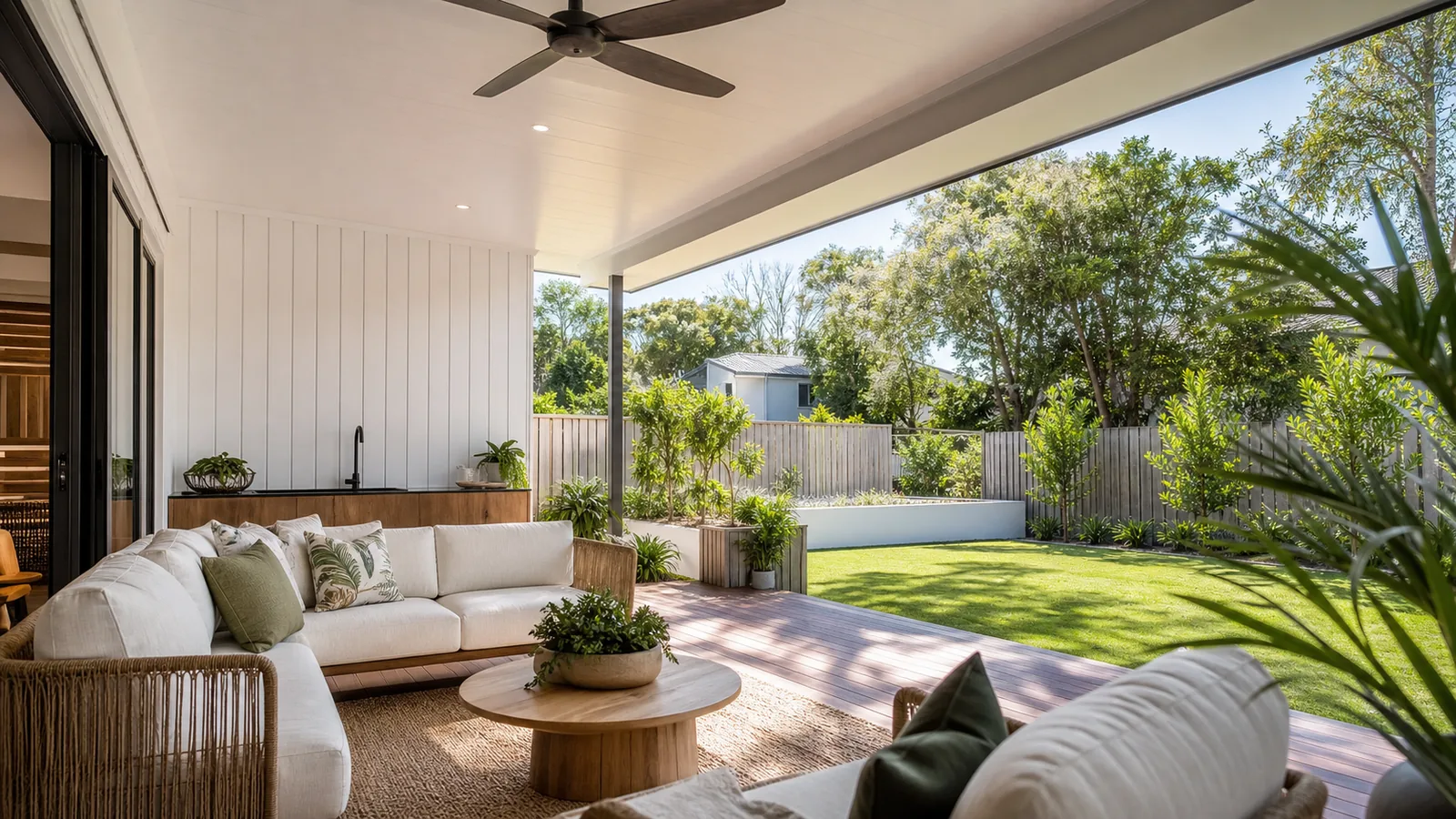
Begin with the evening you want to spend outside
A lighting plan starts with activities. Mark where people will eat, read, talk and walk between the house and garden. A single fitting in the middle of the roof may illuminate the floor while leaving the dining table uncomfortable or the side entrance dark. Write down the activities that matter to your household before counting lights. That gives the electrician something more useful than a request for a standard patio package.
Put furniture on the drawing in its normal used position. Chairs pulled out from the table, a lounge facing the garden and a serving bench all change where light and air movement are wanted. If you often rearrange the space for visitors, show that second arrangement as well. You do not have to accommodate every possible party layout, but the design should support the ordinary evenings you are building the patio for.
For a Bundaberg home used after work, the route from the back door to the seating may matter more than a decorative roof effect. At a Bargara property, the garden or coastal outlook may be something you want to preserve after dark without a bright fitting reflecting in the glass. Explain those priorities in practical terms. The builder and electrician can then coordinate the visible fittings with the roof structure rather than fitting them wherever space remains.
Separate light for tasks, movement and atmosphere
Task lighting helps with a particular activity, such as serving food or reading. General lighting helps people understand the space and move safely. Softer background light may suit conversation when the task lighting is no longer needed. Ask whether those functions should be controlled separately. Turning on every fitting whenever someone steps outside can be inconvenient when others are already seated or a neighbouring bedroom faces the patio.
Consider where shadows fall while a task is being performed. A fitting behind someone preparing food can leave their hands in shadow. A light directly above a dining position may be uncomfortable to look towards when talking. Discuss the direction and spread of light, not only its advertised brightness. The Australian Government's Your Home lighting guide describes matching lighting to its purpose rather than treating every space identically.
Ask to see how proposed fittings look from seated eye level. A decorative fitting may dominate a low roof, while a recessed fitting may create a concentrated bright point. Samples and demonstrations help, but the final effect depends on placement and surrounding finishes. Avoid choosing a fitting solely because it looks attractive on a display wall. Keep a record of the selected product so a last-minute substitution can be assessed against the original lighting purpose.
Put the fan where people sit, then check the structure
The centre of the roof is not necessarily the best fan position. Start with the dining or lounge area where air movement is wanted and ask the installer to assess suitable coverage. If the space has separate seating zones, discuss them explicitly. A large roof does not automatically need a fan centred over an empty passage, and a fan placed to suit symmetry may miss the people who will use it.
A ceiling fan needs an appropriate support arrangement, not just a flat underside. Ask the patio builder and electrician to agree the mounting detail for the exact roof system and fan. Stratco publishes a patio ceiling-fan installation guide with system-specific mounting details. The relevant instructions for your chosen combination should determine the installation, rather than copying a visible bracket from another patio.
Clearances must be checked against the fan manufacturer's instructions and the actual beams, roof slope, finished floor and nearby objects. Keep lights, screens and opening doors in that assessment. A proposed hanging chair, tall plant or storage cabinet can also compete for space. Do not fit a fan or drill mounting holes yourself; coordinate the support and electrical work through the builder and licensed electrician before the roof components are ordered.
Coordinate fan blades, lights and the indoor view
The relationship between fans and lights deserves attention on the reflected ceiling plan. Ask the designer to check whether moving blades could interrupt the light path or create distracting effects in the seating area. A neat-looking grid of downlights can become less comfortable when a fan is added afterwards. Resolve the combined arrangement rather than treating the fan and lighting packages as separate purchases.
Look through the house windows towards the proposed fittings. A light that feels comfortable outdoors may be visible directly from the sofa inside. At night, glass can reflect bright fittings and affect the view of the garden. Ask how the lights can be aimed, positioned or controlled to suit both spaces. Dimming or separate switching may help where the chosen equipment supports it, but compatibility should be confirmed by the electrician.
Also consider the screen position if outdoor blinds are planned. Lights may sit inside or outside the screened area, and controls need to remain reachable when blinds are lowered. The privacy-screen guide explains why night use differs from daytime appearance. Share one coordinated drawing between suppliers so a blind track, fan bracket and light are not all proposed for the same section of beam.
Resolve cable paths while the roof is still a drawing
Some roofing systems provide particular routes or provisions for services; others leave more of the installation visible. Ask the builder and electrician to explain the proposed cable path from the house to each fitting. Agree what will be concealed and what will remain exposed. A promise of hidden wiring is incomplete without a suitable installation method and access for components that may need attention later.
An insulated panel has a finished underside, but that does not mean any light or fan can be installed anywhere within it. Product compatibility and approved installation details matter. Stratco's ceiling-light installation guide shows how a specific lighting system is integrated with roofing. Request the equivalent information for the products being quoted, particularly when fittings are supplied separately from the patio package.
If the patio already exists, expect the electrician to assess access before promising an invisible retrofit. A visible, properly designed route may be more practical than dismantling a roof to conceal everything. Ask what work would be needed and how the finish will look. The existing roof-material comparison provides background, but the actual service route needs a product-specific discussion on your site.
Choose equipment for the real outdoor conditions
Under a roof is not the same as indoors. The fitting's location may still experience moisture, dust or exposure from an open edge. Have the electrician select equipment suitable for its proposed position and the manufacturer's instructions. Avoid buying indoor fittings first and asking for them to be made suitable later. The appearance of a matching indoor and outdoor fitting is less important than whether each is appropriate where installed.
For coastal properties around Bargara, discuss the product's finish, warranty conditions and care instructions for the actual exposure. A generic outdoor description is not enough to compare long-term suitability. Ask whether replacement parts are available and which surfaces need periodic cleaning. Keep those instructions with the patio documentation so maintenance does not depend on remembering a conversation from the quotation visit.
Electrical work in Queensland requires the relevant licence. The Electrical Safety Office warns against DIY electrical work, and its licence search information helps check a contractor. Have the electrician assess the supply and protection needed for the proposed installation. An existing outdoor power point does not by itself establish that new fixed lights, fans or other equipment can simply be connected to it.
Make controls and service access part of the scope
Switches should suit the way people enter and leave the patio. Mark the house doorway, garden approach and any side entry on the drawing. Ask which lights should be available from each position and whether a remote is the sole control or an additional convenience. Consider the person who uses the area most often, including whether small buttons, phone-only controls or an easily misplaced remote would be frustrating.
Plan for ordinary failure and replacement. Ask where light drivers, control equipment and other serviceable components will be located, and how the electrician can access them. Concealing equipment behind a permanently finished surface can make a minor replacement unnecessarily disruptive. The design should explain the maintenance route as clearly as the installation route. Keep product model numbers and warranty documents together so a replacement can be matched accurately.
At handover, operate every intended lighting group and fan control. Check the labels, direction of adjustment and any agreed dimming function with the installer. View the space from the house and seating area after dark if that can be arranged, then raise any placement concerns promptly. Confirm that the final layout and product information reflect what was actually installed, including substitutions agreed during the build.
Describe the switching routine in ordinary language before the electrician finalises the controls. For example, you might want to turn on the path light from the house, use the table light while eating, then leave a lower level of light on while talking. A single switch for every fitting may frustrate that sequence. Ask the electrician to show which proposed controls operate each group, and have household members check that the arrangement makes sense from the door they normally use.
At handover, try those agreed routines after dark with the table in place. Check whether a person walking towards the garden casts a distracting shadow across the meal and whether the seated view includes an uncomfortable bright fitting. Note the control setting used when reporting a concern. This gives the installer a reproducible observation and helps distinguish a control adjustment from a change to the original lighting layout.
Lights and fans: common purchase questions
Should I buy the fan before the patio is designed? Choose a proposed model early enough for its requirements to be assessed, but coordinate the purchase with the builder and electrician. The support, clearances and controls must suit the roof and intended position. Buying first without that check can narrow your options unnecessarily.
Are recessed lights always the neatest choice? They can create a restrained ceiling appearance where the roof system supports them, but they are not the only useful option. Compare the light distribution, service access and look from below. A well-placed surface fitting may better suit an existing structure.
Can one fan serve both a dining table and lounge? Ask the installer to assess the actual layout and the chosen fan's intended coverage. Do not assume the roof's centre represents both activities. If furniture moves often, discuss which arrangement takes priority rather than expecting equal comfort everywhere.
What should be written into the quote? Record products, locations, controls, support responsibility, cable visibility, electrical scope and service access. Identify any allowance that still depends on inspection of the house supply. Keep the roof and electrical quotations coordinated so each trade knows what the other is providing.