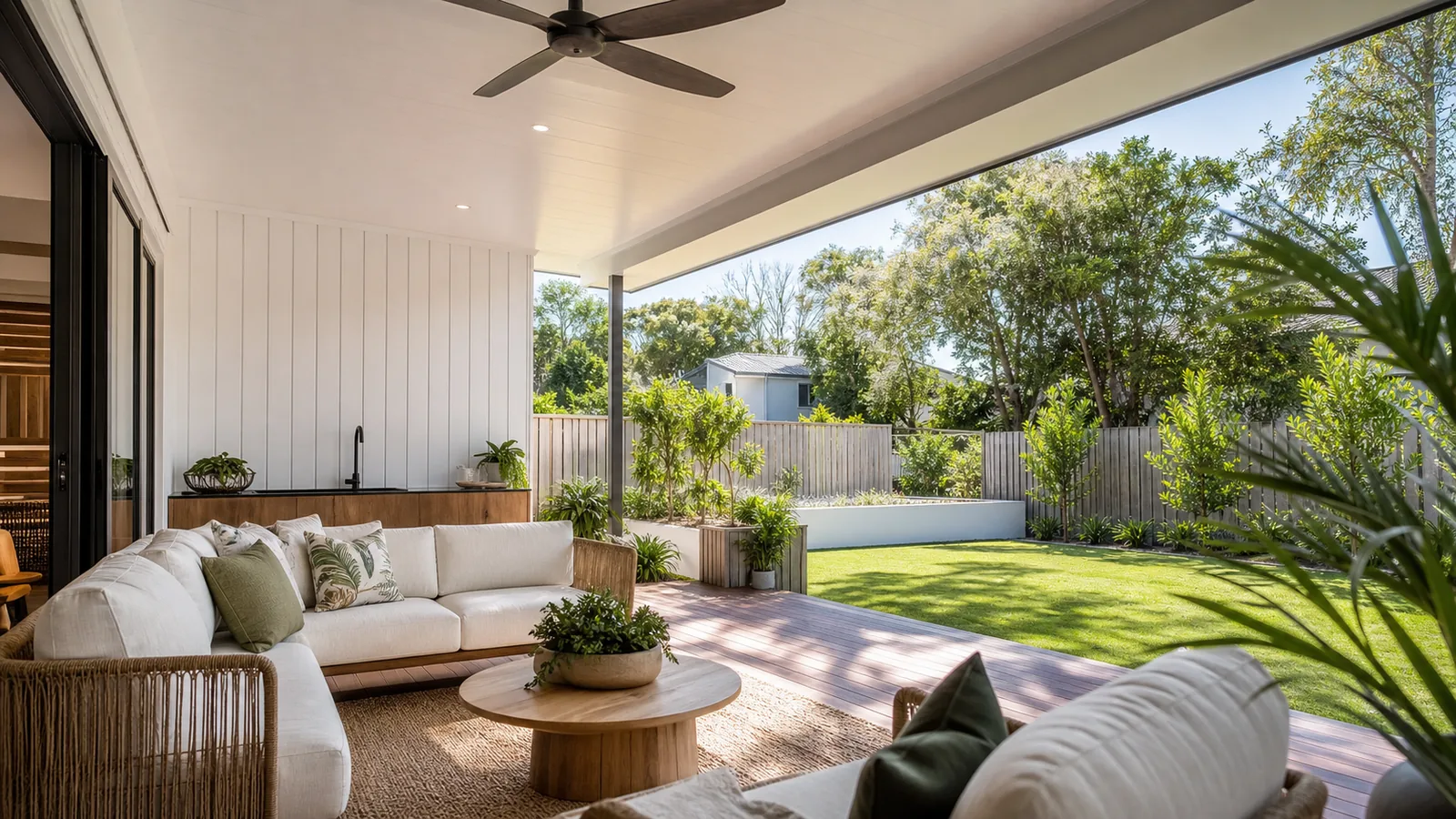
Identify the unwanted sightline before choosing a screen
Privacy is usually about a particular view, not every open side of a patio. Sit where you expect the dining chair or outdoor lounge to go and identify who can see that position from a normal public or neighbouring viewpoint. The line from a footpath, a nearby deck and an upstairs window will each meet your patio differently. A screen selected only from a standing position beside the fence may miss the view that matters when you sit down.
Sketch the seat, the unwanted sightline and the proposed screen position. You may find that moving the furniture solves part of the problem before any screen is added. A short screen near the seating area can also have a different effect from a full boundary-length treatment. Compare those possibilities rather than automatically enclosing the roof's outer edge. Keep useful garden views and the route to the lawn on the same sketch.
For a patio in Bargara, the outward view may be a key part of why the area is used. In Avoca or Kepnock, a side-facing neighbour's window may be the concern. Work from the actual view rather than assuming coastal homes need one product and suburban homes another. Explain whether you want privacy while dining, reading, using a spa or simply walking between the house and garden, because the relevant height and position change.
Test daytime privacy and night privacy separately
A mesh that looks private from outside in daylight can behave differently after dark. The relationship between lighting on each side affects what people can see. Ask the supplier to demonstrate the exact fabric under conditions relevant to your use. If evenings are important, do not make the decision from a small daytime sample alone. The appearance from inside and the privacy from outside are separate questions.
Clear material can reduce some exposure to weather while retaining a view, but it should not be treated as a privacy solution. Translucent and opaque materials offer different visual effects. Ask which surfaces will be visible from the house and whether a screen will make the patio feel enclosed when it is not being used. A treatment that looks acceptable during a party may feel intrusive from the kitchen every morning.
Include your lighting plan. A bright fitting behind a seated person may make them more visible through some fabrics than expected. Rather than trying to solve that with progressively heavier screening, discuss the position and direction of lights at the same time. Our patio lighting guide explains how to start from the table, lounge and walking route. The screen supplier can then assess the material with those uses in mind.
Compare fixed panels, slats and operable blinds
Fixed panels provide a consistent visual barrier without a daily operating routine. They can suit a sightline that is unwanted all the time, but they also permanently alter the view from the patio and house. Ask what the panel looks like from both sides, where its supports go and whether the lower edge affects cleaning or drainage. A decorative finish does not remove those practical questions.
Slatted screens can interrupt selected angles while leaving gaps. Their effect depends on slat direction, spacing, depth and the angle of view. Compare a sample in the intended orientation and look through it from the actual seating position. A photograph taken straight on may conceal how open the screen looks from an angle. Discuss whether horizontal or vertical lines suit the house, but settle the privacy performance before treating the choice as purely decorative.
Operable outdoor blinds offer a different compromise: the opening can be clear at some times and covered at others. That flexibility brings tracks, bottom bars, handles or motors that need space and access. Ask where the blind sits when retracted and whether it blocks part of the view above eye level. For a large opening, consider how it will be operated by the person who uses the patio most often, not only during a sales demonstration.
When a supplier brings a slat or fabric sample, check which face and orientation it represents. Holding a small sample flat against a window can give a different impression from the proposed angled panel at the patio edge. Have one person sit in the normal chair while another stands at the unwanted viewing position, where access is permitted. Move the sample through the proposed positions and describe what remains visible. This is a practical comparison aid; the supplier still needs to confirm the finished product's dimensions and installation details.
Also decide what the patio should look like when nobody is home. If the household will routinely leave an operable screen open, a modest fixed panel beside the most exposed chair might suit everyday privacy better than relying on someone to lower a large blind. Compare that smaller intervention with enclosing the whole side. It can keep more of the outlook and walking space available.
Preserve the openings that make the patio comfortable
Before screening an opening, observe how the space feels with the existing sides open. Note where air movement is noticeable and where the room feels still. This is a practical observation rather than a prediction that the same breeze will always arrive. Keep the useful openings in the design brief and ask how the proposed screen material changes the finished experience.
Your Home's passive cooling guidance discusses shading and air movement as parts of comfort. A patio screen should be considered alongside the roof and house openings. Closing several sides to stop glare or rain can change the space you originally wanted. Compare partial treatment, adjustable screening and a different seating location before choosing a full enclosure.
A ceiling fan may improve comfort where appropriately selected and installed, but it does not make every enclosure suitable. Do not use a fan as a substitute for assessing the intended use, ventilation or appliance requirements. If outdoor cooking or heating is planned, discuss the actual equipment with the relevant installer and follow its instructions. A patio that is open when built may be used quite differently once screens are lowered.
Treat wind instructions as part of the purchase
An outdoor blind is an operable product with instructions, not a permanent storm wall. Ask for the manufacturer's operating guidance for the exact system, including what to do when wind increases and whether the blind should be fully raised or fully lowered in particular conditions. Keep those instructions accessible to everyone who uses the patio. Avoid relying on a salesperson's general description of the product as strong.
For example, Ziptrak's wind-use guidance distinguishes ordinary operation from more severe weather and explains that wind pressure can affect movement. Read the guidance for the product actually quoted. It should inform how you will use the patio, especially when leaving home or when weather changes while the opening is screened. Do not transfer a claimed rating for another size or installation to your own opening.
Ask the patio designer to review proposed screen loads and fixing locations before installation. Adding large side panels changes the structure being considered, and an existing beam should not be assumed suitable just because it offers a convenient fixing surface. This is relevant whether the patio is new or already built. Keep the roof installer and screen supplier involved in the same arrangement so responsibility does not disappear between them.
Keep doors, paths and furniture workable
Screens create edges that people need to move through or around. Draw the route to the house door, garden, side gate and any external tap. An opening used repeatedly should not require moving a dining chair or bending under a partly lowered blind. Ask where handles and controls sit and whether they can be reached from the normal walking path.
Look closely at floor-level details. Tracks, bottom bars and support posts may affect cleaning or create an awkward step in a route used by children or someone with limited mobility. Discuss those needs explicitly with the supplier. If a level accessible route is required, have it assessed as part of the project rather than assuming a screen installer can preserve it without coordination. A convenient opening should remain convenient in both open and closed configurations.
Furniture should also be shown in its used position. A lounge pushed against a blind can obstruct operation, and a dining chair pulled out may collide with a screen panel. Leave room for cleaning both faces where required by the product instructions. For a narrow patio, the best solution may be less screening in a better location. Avoid sacrificing the usable width of the whole room to solve a sightline affecting one seat.
Coordinate screening with the roof and adjoining room
A screen can change daylight in rooms behind the patio as well as under the roof. Look from inside the house while considering samples and proposed positions. If the adjoining room already has limited light, compare the complete roof-and-screen arrangement before ordering either. The daylight guide helps identify which window and viewing position need attention.
Think about services early. Motorised blinds, lights and ceiling fans can compete for cable paths and mounting positions. Have the appropriate licensed electrical trade coordinate any electrical work with the product suppliers and patio builder. Ask how controls will be reached, what happens when power is unavailable and how components can be serviced. A neatly concealed installation still needs a workable maintenance plan.
Keep colours and finishes tied to real samples. A dark mesh, pale slatted screen and solid panel may each look different from the patio, garden and kitchen. Review them against the existing house materials, including any intended coastal-product care requirements at a Bargara address. Ask for the exact product and finish in the quote so the final installation is not chosen from a vague description such as premium privacy screen.
Privacy-screen questions worth asking
Should I screen every side at once? Start with the actual privacy and glare problems. Ask whether treating one side or moving the seating would be enough. If full enclosure is the intention, have the designer assess that complete arrangement rather than treating it as a collection of unrelated accessories.
Will mesh let me see out without anyone seeing in? Do not assume that result in all lighting conditions. Ask for a demonstration of the specific material from both sides, including evening use. The screen's appearance and the balance of light across it affect the experience.
Can blinds be added to an existing patio? They may be possible, but the supplier needs to assess dimensions, supports, fixings and operation. Ask the original patio builder for available drawings and involve the appropriate designer where required. An existing roof is not automatic approval for any screen size.
What belongs in the written scope? Record the product, material, finish, opening sizes, supports, operation, access requirements and responsibility for electrical work. Include manufacturer care and wind-use instructions in the handover documents. If privacy at night is a priority, state it clearly before a product is selected.